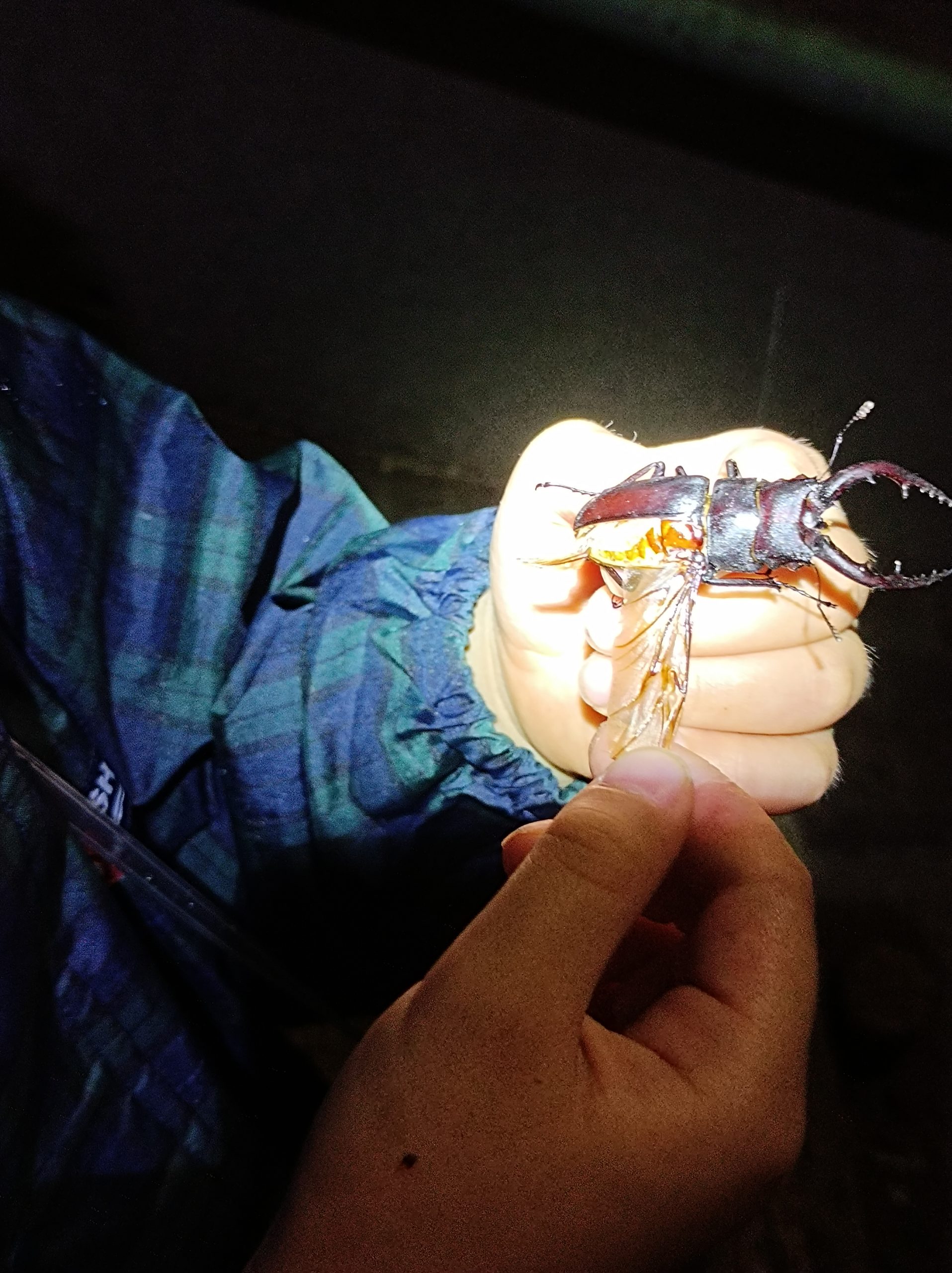
The summer insect collecting season is finally upon us! Children especially love to encounter stag beetles in the forest at night. However, collecting at night can be dangerous and it’s dark, making it hard to see where you’re going.
Some people may be worried, saying, “I know I need a light, but how do I choose one? I have no idea how to choose…”
Don’t worry! By reading this article, even beginners can confidently say, “This is the one I’ll choose!”
as they will be able to grasp the key points for choosing a headlamp for insect collecting. In fact, I have tried out a variety of lights since my son first started insect collecting with his child at age four. I will answer each question based on my experience, such as what changes depending on the price and what features are convenient. By reading this article, you will know how to choose the perfect headlamp for your first nighttime insect collecting experience!
So, get ready and head out to collect insects in the summer!
- Enjoy insect collecting safely at night! Basics of choosing a light for beginners: Headlamps are recommended
- Why we recommend using a headlamp instead of a handheld flashlight [Safety]
- [Brightness] 300 lumens or more is essential! Choose a type that maintains constant light output.
- Durable headlamps and flashlights are recommended
- Headlamps and flashlights are available in both rechargeable and battery-operated versions.
- Price differences between insect collecting headlights and headlamps
- 3 recommended headlamps for beginner insect collectors
- Black Diamond Equipment Spot 400 (BD81308) is a headlamp for those who want to never make a mistake.
- Highly recommended for its cost-effectiveness. The classic GENTOS COB LED headlight, COMBREAKER series CB-643D.
- Recommended for those looking to save money but still want to make the right choice: the TJM Design Tajima LED Headlight LE-M351D.
Enjoy insect collecting safely at night! Basics of choosing a light for beginners: Headlamps are recommended
The lights used for collecting rhinoceros beetles and stag beetles are
- Ensures the safety of children
- There is enough light
- Hard to break
Keep these three points in mind when making your selection.
Why we recommend using a headlamp instead of a handheld flashlight [Safety]
First of all, is it okay to use a handheld flashlight?
Handheld flashlights and penlights are not bad at all.
Even experienced insect collectors prefer to use handheld lights.
However, we definitely recommend a headlamp for beginners, and especially for children, a headlamp is the only option.
This is because nighttime collection locations, such as forests or parks with many trees, are often dark and difficult to walk in. A headlamp allows you to use both hands freely, making it extremely convenient for holding the insect net and insect cage. Children often want to hold the net themselves, and after catching their first insect, they often want to hold the insect cage as well.
A handheld light is not only dangerous because your hands are occupied, but there is also the risk of accidentally dropping it.On the other hand, a headlamp is attached to the head, so even if you are some distance away, the brightness makes it easy to see where your child is, which is very reassuring.
[Brightness] 300 lumens or more is essential! Choose a type that maintains constant light output.
Brightness is one of the most important things to check. You might think, “If it’s a light from a famous outdoor brand or electronics manufacturer, it’s sure to be good!” but that’s a big pitfall. Each light has its own purpose, and not all lights are suitable for insect collecting.
In conclusion, we recommend that you choose a headlamp with a brightness of 300 lumens or more. In particular, choose a light that can maintain a constant brightness of 300 lumens or more.
Some of you may be wondering, “What is a lumen?” Lumens are a unit of brightness, and product descriptions will often refer to them as “lumens” or “lm” so please refer to this information.
Why a headlamp with 300 lumens or more is recommended
When collecting insects at night, you need to not only light your feet and hands, but also shine a light on trees several meters ahead to search for rhinoceros beetles and stag beetles. It is important that the light reaches high up in the tree and is bright enough to be seen.
Therefore, you need a minimum brightness of 300 lumens or more. From personal experience, it is difficult to find rhinoceros beetles and stag beetles without a brightness of 300 lumens or more, so 400 lumens or more is useful.
Reason for “always at least 300 lumens”
Many headlights have a “power mode” that temporarily brightens the light while the button is pressed. For example, “Normal mode is 100 lumens, but it becomes 300 lumens while the button is pressed.” Be careful if the product description says “Maximum 300 lumens.”
This type of headlamp is definitely not recommended for insect collecting. You have to keep pressing the small button, which makes your hands full and is extremely inconvenient. In fact, I myself have had the bad experience of choosing this type of headlamp with a well-known outdoor brand.
Durable headlamps and flashlights are recommended
Regarding durability, it’s a good idea to refer to customer reviews.
Generally speaking, well-known brands tend to have reliable warranties and durability.
Among my friends, headlamps from the outdoor brand Montbell are popular, and I often hear that they can be used for more than five years.
Headlamps and flashlights are available in both rechargeable and battery-operated versions.
Headlamps come in two types: rechargeable and battery-operated. This is a matter of preference, and there isn’t much difference between the two.
If I had to say, rechargeable ones are brightest when you first buy them, but the light output tends to gradually decrease over time. Battery-operated ones have the advantage that you can bring spare batteries and change them on-site.
However, in actual use, I think it ultimately comes down to personal preference. Nighttime insect collecting with children will probably only last about three hours, so either type should work well enough.
Price differences between insect collecting headlights and headlamps
The price difference mainly depends on the brightness and durability we’ve discussed so far, as well as the number of light sources (bulbs).
If you’re looking for something around 400 lumens, the number of light sources won’t have much of an impact on how easily heat builds up.
However, when considering a high-intensity headlamp with an output of over 1000 lumens, the amount of heat generated and how it builds up will differ between a model that produces 1200 lumens from a single light and a model that uses multiple lights (for example, three) to produce a total of 1200 lumens. For this reason, we recommend careful comparison when considering a high-intensity headlamp.
3 recommended headlamps for beginner insect collectors
- For those who absolutely cannot afford to fail: Black Diamond (around 8,500 yen)
- Highly recommended for its value for money. A classic. GENTOS (Gentos) – around 3,000 yen
- Recommended for those who want to keep the price down but don’t want to make a mistake. TJM Design (Tajima) Around 2,500 yen
Black Diamond Equipment Spot 400 (BD81308) is a headlamp for those who want to never make a mistake.
Shipping cost: around 8,500 yen
Black Diamond is an American mountaineering equipment brand that is especially popular among climbers and skiers. Its products
contribute to ensuring safety during mountaineering, allowing you to adjust the illumination from broad to pinpoint. The brightness adjustment function allows you to optimize the lighting to suit the surrounding conditions, and the long battery life makes it a reliable way to prevent trouble while climbing.


Highly recommended for its cost-effectiveness. The classic GENTOS COB LED headlight, COMBREAKER series CB-643D.
Shipping cost: around 3,000 yen
GENTOS is a Japanese lighting manufacturer highly acclaimed for its durability and outdoor gear.
The GENTOS COMBREAKER series CB-643D achieves a brightness of over 400 lumens.
*As mentioned in “Brightness: 300 lumens or more is essential! Choose a model that maintains constant light output,” this light does not only brighten while pressed, but also changes the light intensity with the flip of a switch.
Priced at around 3,000 yen, this is a recommended item for beginner insect collectors.

Recommended for those looking to save money but still want to make the right choice: the TJM Design Tajima LED Headlight LE-M351D.
Shipping cost: around 2,500 yen
TJM Design Tajima headlights are developed by TJM Design Co., Ltd., a construction tool manufacturer, and offer highly functional products at low prices.
As a construction tool manufacturer with a large customer base and the ability to easily improve quality and price, the company has continued to improve product performance, offering high-performance, low-priced products.
