
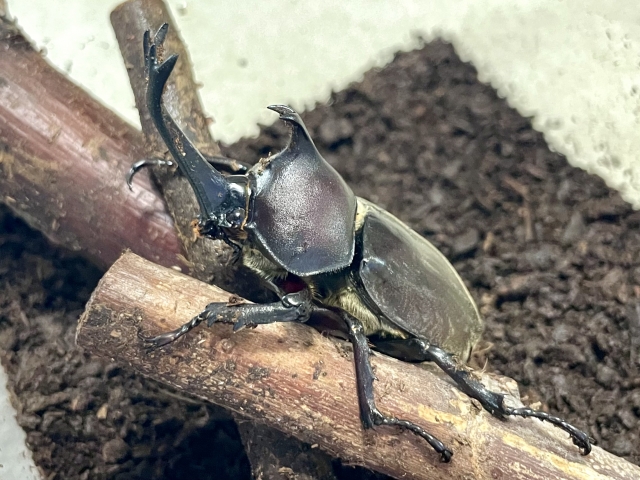

For parents who want their children to find something they can be passionate about or want to inspire an interest in nature, raising rhinoceros beetles is the perfect experience!
Living with rhinoceros beetles, whose small bodies contain the dramatic stories of life, will stimulate children’s curiosity and provide them with an experience filled with learning and excitement.
If your child says they want to raise rhinoceros beetles, now is the perfect time!
This article explains the basics of rhinoceros beetle raising that parents need to know so that their children can successfully raise them, in an easy-to-understand manner for beginner parents and their children.
Basic information you should know before raising a pet
The lifespan of rhinoceros beetles and the period when they can be kept are from June to the end of October.
Rhinoceros beetles that reach adulthood in early summer reach the end of their lifespan in the fall of the same year.
Adult rhinoceros beetles do not survive the winter.
When raising rhinoceros beetles at home, it is best to aim to keep them healthy from the day you catch them until the end of October.
Raising rhinoceros beetles: What to prepare before starting
What you need to raise beetles:
- Breeding case
- Matt (Sat)
- Perch
- bait
First, let’s prepare these.
The rest are just ideas to make the rhinoceros beetle’s life more comfortable. Prepare them as needed.
Case of beetle breeding
Generally, rhinoceros beetles are kept one per case. If the purpose is breeding, it is okay to keep males and females together in one case for a few days to a week for mating.
Keeping multiple rhinoceros beetles in the same case can weaken the beetles, as males may fight with each other or the male and female may mate excessively, wasting their energy.
Therefore, in order to keep rhinoceros beetles healthy for a long time, the general rule is to keep them one per case, and even if you are breeding them, you should only keep a male and female together in one case for a few days to a week just for mating purposes.
Mats (insect mats, leaf mold)
The basis for raising rhinoceros beetles is an insect mat made mainly of leaf humus.
You can get leaf humus from people near where you caught the beetles, or you can purchase insect mats at insect shops, home improvement stores, online stores, and 100-yen shops in the summer.
When raising adult rhinoceros beetles, lay a mat approximately 3-5cm deep from the bottom of the container.
When raising beetles or other living creatures, it is important to create an environment as close as possible to the creature’s original habitat. When raising rhinoceros beetles that live in leafy woods, lay an insect mat mainly made of leaf compost.
If you are looking to buy insect mats, we also recommend husk chips and sphagnum moss.
There are many different types of insect mats, including husk chips and sphagnum moss.
Insect shops and, in the summer, even 100-yen shops sell insect bedding that can be used in place of leaf mold or soil.
Husk chips and sphagnum moss used to raise rhinoceros beetles absorb the beetle’s urine, reduce odor, and prevent the growth of bacteria.
These mats are also recommended because keeping the case clean and comfortable for rhinoceros beetles helps them live longer.
What is Husk Chip? [Insect Rearing Terminology Explanation]
This flooring is made from shredded coconut husks.
What is Sphagnum moss? [Insect rearing terminology]
This flooring is made from dried moss.
perch
The beetle enclosure should include perches for the beetles to hold on to.
When a rhinoceros beetle flips over on a flat surface, it has a hard time getting up on its own, so a perch provides a support and foothold for it to grab and get up.
The guideline for size and quantity is to place multiple perches of appropriate size so that the beetles’ legs can reach them no matter where the case is turned over. If there are not enough perches, the beetles will continue to move their legs when they turn over, which will drain their energy. It is a good idea to place a slightly larger number of perches so that they can easily grab onto something.
Food for rhinoceros beetles
I recommend insect jelly
The most recommended food for rhinoceros beetles is insect jelly. During the summer vacation period, it is easily available at supermarkets and 100 yen shops.
During the hot summer months, adult males will consume about one cup per day. As the weather cools, their appetite decreases, so be sure to add more jelly when it runs out.
Many stores stop stocking insect jelly once September arrives, so if you plan to continue raising insects after September or October, we recommend purchasing extra insect jelly.
Baits to avoid
Water-rich vegetables and fruits, such as watermelon and cucumber, produce a lot of rhinoceros beetle excrement and urine, making the insect mat more susceptible to soiling. If the inside of the enclosure becomes unsanitary, it can harm the health of the rhinoceros beetles, so it’s best to avoid these foods. They tend to rot easily, especially in the summer, and can cause a foul odor.
Useful beetle rearing supplies for a more comfortable life
To maintain a more comfortable breeding environment, it is a good idea to provide a fly trap and feeding station.
A fly shutter is a piece of nonwoven fabric that covers the case and prevents flies from getting in. If flies get into the breeding case, they will lay eggs on the insect mat, which not only worsens the breeding environment but also causes flies to emerge from the breeding case, so using a fly shutter can prevent this.
The feeding tray is a stand to prevent the insect jelly from falling over. If the insect jelly falls over and spills, not only is it a waste, but it also soils the insect mat and worsens the breeding environment, so having a feeding tray makes it easier to maintain a comfortable breeding environment.
Should the enclosure be indoors or outdoors?
When raising rhinoceros beetles, some people may wonder whether it is better to place the breeding case indoors or outdoors. The bottom line is that indoors is the best place to raise rhinoceros beetles.
Reasons why we recommend keeping your pet indoors
Although rhinoceros beetles are often thought of as summer insects, they are actually not resistant to heat. The hot and humid environment of Japan’s summer is harsh for rhinoceros beetles and causes them to become weak. Environments above 30°C are particularly dangerous.
If you keep them indoors, you can avoid direct sunlight and easily control the temperature with an air conditioner, maintaining an environment where rhinoceros beetles can live comfortably.
Precautions when raising them outdoors
When raising them indoors, there are issues such as the smell of beetle excrement and matting, the sounds of the nocturnal beetles being active, and the possibility of the beetles escaping if the lid of the breeding case is not closed tightly.
If you cannot keep them indoors and must keep them outdoors, make sure to place them in a well-ventilated, shady area that is not exposed to direct sunlight.
Caring for rhinoceros beetles
Caring for rhinoceros beetles
- Feeding
- spray bottle
- Mat replacement
It’s a very simple game,
and it’s this simplicity that makes it so easy for many children to try.
Feeding the rhinoceros beetles
Be sure to add more food to your rhinoceros beetles when they are running low. Adult males will consume about one cup of insect jelly per day, especially during the hot summer months. This is only a guideline, and the amount eaten will vary depending on the individual beetle and the temperature. Keep an eye on how much jelly is being consumed, and always make sure to provide fresh jelly.
As the weather cools towards autumn, the beetles’ appetites will gradually decrease. Therefore, there is no need to add jelly at the same pace as in summer. Adjust the frequency of adding jelly by watching how much is being used up. When you notice that there is uneaten jelly, it is important to replace it with new jelly before it spoils.
spray bottle
Use a spray bottle to spray water onto the surface of the insect mat until it is lightly damp. If you give it too much water, the mat will turn into mud and become a breeding ground for bacteria, so try to keep the surface lightly damp with a spray bottle.
How often should you change the insect mat and soil?
The insect mat will become dirty with beetle excrement and leftover insect jelly.
Replace the mat when it becomes muddy or starts to smell bad.
If mites are found on rhinoceros beetles
When raising rhinoceros beetles, mites may appear.
A small number of mites is not a problem, but if there are many, they can weaken the rhinoceros beetle.
To remove the mites, gently brush them with a soft toothbrush.
Tips for moving rhinoceros beetles
If a rhinoceros beetle clings to clothing or curtains, gently nudge it by the rear to encourage it to walk, then move it to a perch or piece of wood. Be gentle, as pulling too hard can cause its legs to come off.
Beetle breeding event
Raising rhinoceros beetles is not just about keeping them; you can also observe the cycle of life by watching them mate, reproduce, lay eggs, and raise the larvae that hatch from the eggs until they emerge. You can observe various changes up close, such as mating, the moment of egg-laying, the process of larvae growing, their transformation into pupae, and their emergence into adults. This is a valuable opportunity to learn about the life cycle of rhinoceros beetles.
Sharing this excitement with mom and dad will be a great joy for your child. Observing together will foster your child’s intellectual curiosity and deepen communication between parent and child. Keeping a living creature comes with responsibility. By watching the rhinoceros beetle grow until the very end and nurturing it with care, your child will learn the importance of life.
Konchan Net supports raising rhinoceros beetles, a fun activity for parents and children!